Whose Side Is Tether Really On?
Critics view Tether as a Trojan horse built to prolong U.S dollar dominance. Others view it as a vanguard for the Gold Standard's return. In today's article, we consider both sides of the stablecoin.


What do you call a company that buys gold faster than almost every central bank on earth?
And what do you call that same company when it is simultaneously one of the biggest holders of US Treasuries on the planet?
You call it Tether. And you should probably start paying attention to it…
The world’s biggest stablecoin issuer bought 26 tonnes of bullion in Q4 2025 – a pace that, according to Jefferies, ranked third globally, behind only the central banks of Poland and Brazil. At its peak, Tether CEO Paolo Ardoino said the company was buying up to 2 tonnes of gold per week. That’s more than USD 1 billion of gold. Accumulated every single month. By a company most investors had never heard of a year ago…
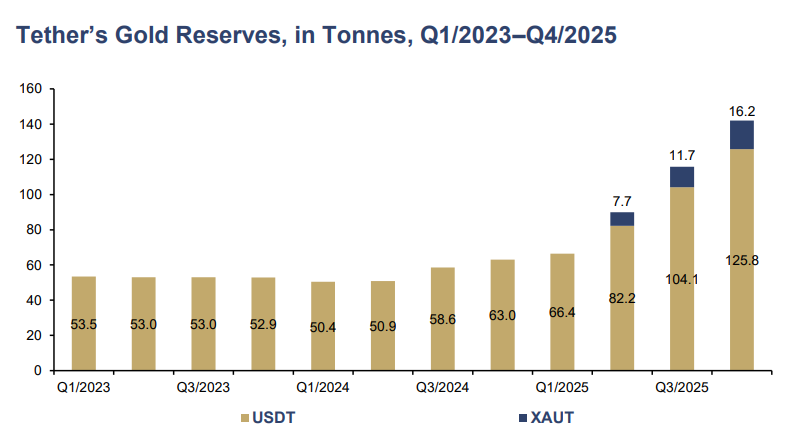
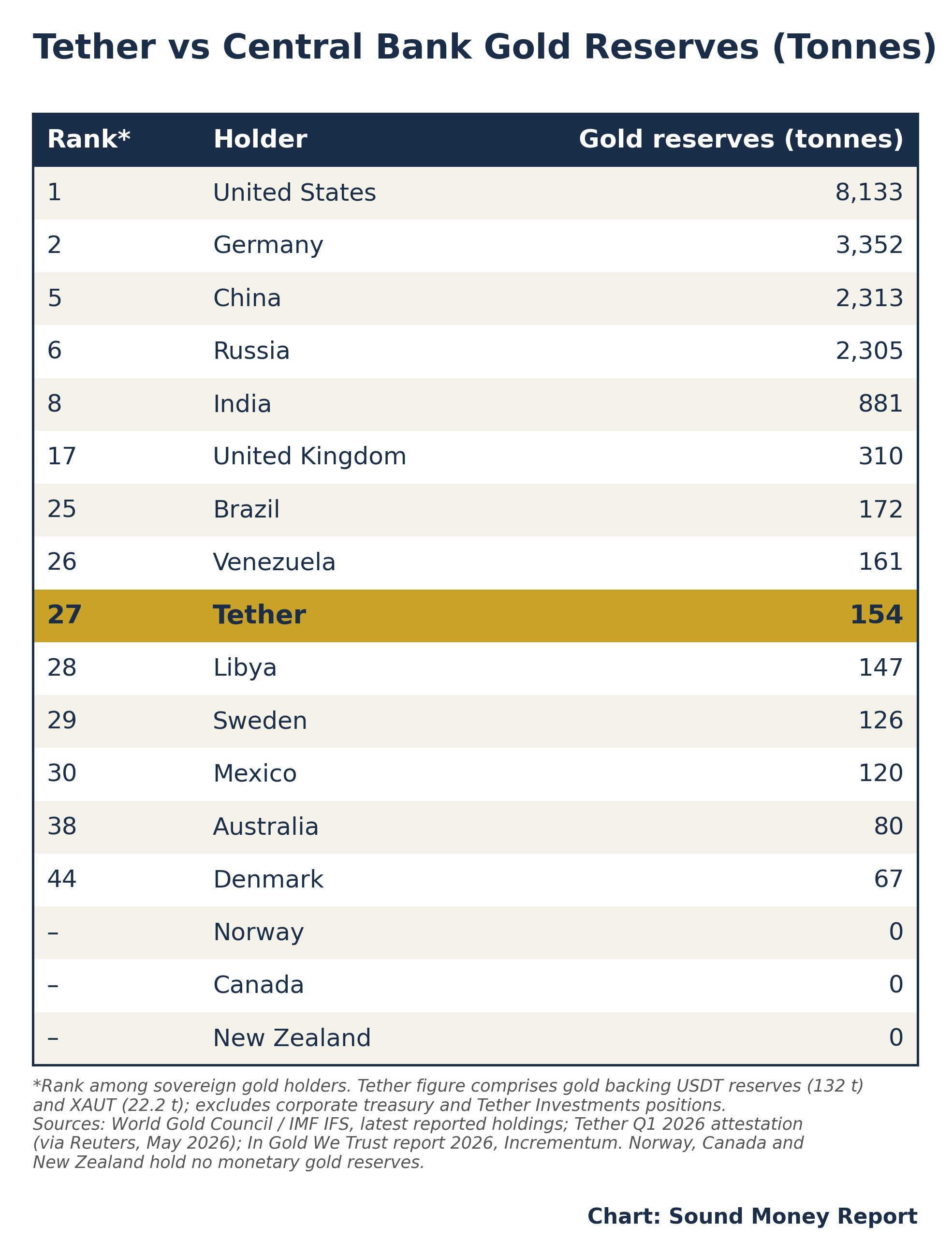
After a further 6 metric tons of gold reserves were added to back USDT in Q1 2026, Tether’s golden hoard now stands at a whopping 154 tonnes. Stored in Swiss vaults that the company owns outright, the stash is worth over USD 20bn at today’s USD 4100/oz gold price. Tether’s Head of Special Projects, Juan Sartori, calls it “probably the biggest private reserve of physical gold in the world.” In fact, if Tether were a sovereign nation, the current stash would place it around the 27th largest gold holder globally, comfortably ahead of the supposedly “developed” nations of Australia, Canada, and Sweden.
So, Tether should be championed as a positive force for gold investors, right?
Perhaps.
But before crowning it so, we ought to consider the other side of the ledger…
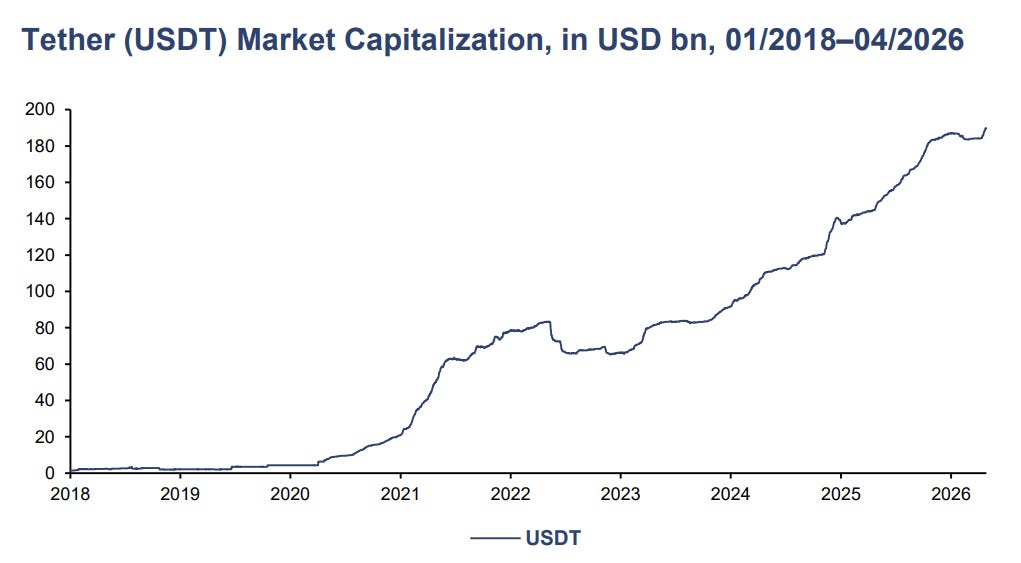
That is, while Tether is clearly a rampant accumulator of gold, its entire business is simultaneously centred around the US dollar. As of April, roughly USD 185bn of USDT was circulating worldwide. And behind almost every one of those digital dollars sits a real short-dated Treasury bill.
That not only makes Tether a crucial, price-insensitive buyer of US government paper, but also the 17th largest holder of US debt on the planet, ahead of US-allied nations such as Germany and South Korea.
Washington passed the GENIUS Act precisely to harness that demand from whales like Tether. And the carry trade has generated more than USD 10bn in profit in the past year alone, over USD 30bn since rates began rising in 2022.
So, which is it? Is Tether the dollar’s Trojan horse, wheeled deep inside the sound money citadel? Or the vanguard of the gold standard’s return? Can one company really be both?
Our sister publication, the In Gold We Trust report, devotes an illuminating chapter to that very question. “A Golden ‘Stabilisation’ Op in Plain Sight” was superbly written by Izabella Kaminska, the journalistic force behind The Peg, a new stablecoin-focused publication, and The Blind Spot. Previously senior finance editor at Politico and editor of the FT’s award-winning Alphaville blog, few writers are better equipped to decode what Tether is actually building. Her chapter includes an exclusive interview with Sartori, and it is the basis for everything that follows.
In today’s deep-dive, we extract the key takeaways from the chapter for SMR readers, as we seek to answer an increasingly critical question for sound money investors:
Are critics right to dismiss Tether as some kind of US government psyop built to prolong dollar dominance?
Or could it actually be an ingenious fiat off-ramp that is quietly paving the way for a gold-backed monetary revolution?
