Weekly Nuggets #34
This thirty-fourth edition of the Weekly Nuggets further reinforces the sense that the global economy is in a period of mounting instability.


Interestingly, financial markets, geopolitics, demographics, and monetary policy are becoming increasingly intertwined. From rising sovereign bond yields and persistent inflationary pressures to accelerating resource competition and shifting trade dynamics, the global macro landscape continues to evolve in ways that challenge many of the assumptions that defined the post-2008 era.
Several of this week’s discussions revisit the growing fragility of the debt-based monetary system and the difficult position central banks now face as they attempt to balance inflation control with financial stability. Furthermore, the renewed attention surrounding gold, commodities, and mining equities reflects a broader reassessment of hard assets in a world characterized by fiscal deterioration, geopolitical fragmentation, and declining trust in fiat currencies.
The material gathered this week also highlights other important long-term themes shaping the global economy, including the transformative effects of the AI-driven investment boom, the reconfiguration of global trade flows, and the deepening demographic crisis affecting much of the developed and developing world alike.
As always, the Weekly Nuggets seeks not to predict short-term market fluctuations, but rather to identify the deeper structural trends increasingly defining the emerging macroeconomic order.
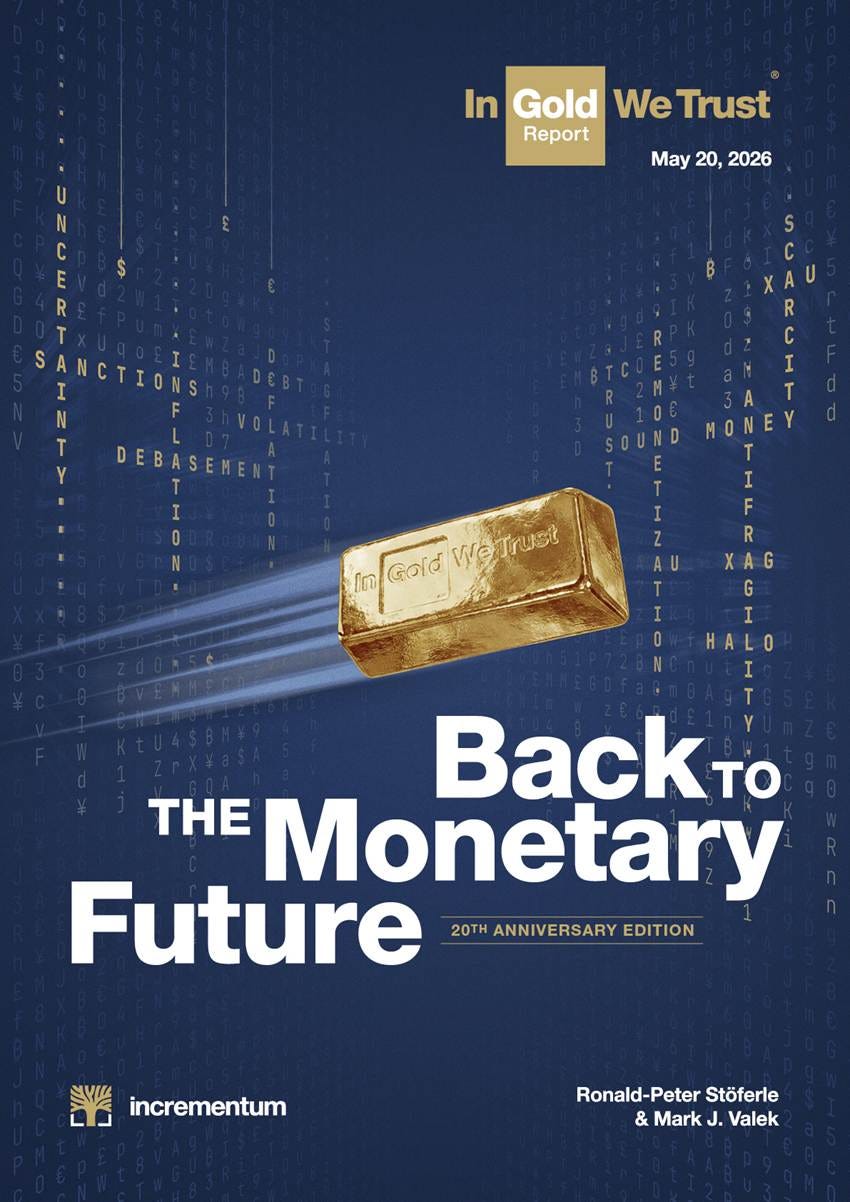
Importantly, this week also marked the release of the highly anticipated In Gold We Trust report 2026, titled Back to the Monetary Future, produced by our friends at the In Gold We Trust Report. Celebrating its 20th anniversary edition, this year’s report expands even further into the themes of sound money, precious metals, geopolitics, monetary transformation, and the future of the global financial system, while also receiving a significant visual overhaul.
Tweets/Notes/Posts
1/ This is for the doomers that say the mining party is over. Patently, as markets concede that the prices of precious metals and commodities are going to stay high or even climb further for longer than expected, the rally in mining stocks will resume.
2/ Not all of it is going to China. Clearly, a big chunk has remained in Great Britain, likely secured in the LBMA vaults.


3/ On another note, the rise in global bond yields refuses to let up. Is this all due to the energy crisis that is lifting prices, in general, across the world?


4/ Apparently not! Since yields are soaring while inflation expectations stay constant, the reason must be that they’ve become less safe to hold.

5/ Another asset class that continues to climb unrelentingly is global equities. Except that their rise is beneficial to their holders.


6/ Needless to say, the sectors that are driving the rally in the stock market are those related to the AI boom. The demand for chips and alike has been truly tremendous.


7/ Regardless of this boost in imports of chips, it appears the trade deficit of the US has significantly been reduced. Could the Trade War flip the deficit into a surplus?

8/ With the support of the oil and gas exports that have jumped since the closure of the Strait of Hormuz, I believe it’s not that unimaginable for the US to be a surplus country soon. However, to achieve this, the oil flows out of the Persian Gulf may never return to what they were.
9/ Maybe what may never return is a sustainable fertility rate. In all seriousness, of course, one day this trend will hit bottom. Where is and when will that bottom hit is the real mystery.


10/ Thus, don’t be surprised if real estate carry on their fall in Asia. Perhaps, the West’s house prices will eventually start to mirror this downward trajectory… or at least reach a ceiling.


Cartoons/Memes
1/ Possibly, when that happens, we can discern that the Fourth Turning is taking place.


Podcasts/Interviews/Presentations
1/ Press Conference | Publication of the In Gold We Trust Report 2026 (EN) | In Gold We Trust Report

https://events.streaming.at/gold-20260520-en
Commentary
The official press conference for the publication of the In Gold We Trust report 2026 took place on May 20, marking the release of the landmark report’s 20th anniversary edition. This year’s edition, titled Back to the Monetary Future, represents the most extensive and visually refined version of the report to date, expanding its scope beyond precious metals to include a broader exploration of hard assets, geopolitics, monetary transformation, commodities, and the evolving global financial order.
Hosted by Ronald-Peter Stoeferle and Mark J. Valek, the press conference was conducted in both German and English, reflecting the report’s growing international audience and reach. The event highlighted many of the report’s core themes, including the remonetization of gold, de-dollarization, inflation dynamics, and the growing relevance of silver and commodities in an increasingly fragile macroeconomic environment.
As a partner of the In Gold We Trust Report, the Sound Money Report takes particular pride in this year’s milestone edition. The connection is especially meaningful given that the SMR itself was founded by Ronnie Stoeferle, co-author of the IGWT report series, together with Ted Butler, who once again contributed this year with his renowned analysis of the silver market.
Two decades after its first publication in 2007, the In Gold We Trust report continues to stand as one of the most respected and widely followed publications in the precious metals and macro research space. In other words, it has become a testament to the enduring relevance of sound money principles in an era of profound monetary and geopolitical change.
2/ “This Market Is Absolutely Insane”, GOLD, Bonds & The Decay of Trust — Matthew Piepenburg | Soar Financially
Commentary
In a recent interview on the Soar Financially podcast, hosted by Kai Hoffmann, Matthew Piepenburg – partner at Von Greyerz Gold – shared a compelling macroeconomic outlook centered on the growing importance of gold, rising bond yields, and the increasingly fragile position of central banks.
Throughout the discussion, Piepenburg contended that today’s financial system has entered a period defined by structural debt problems, persistent inflationary pressures, and diminishing confidence in fiat currencies. Against this backdrop, gold is re-emerging not merely as a defensive asset, but as a critical monetary barometer reflecting deeper systemic imbalances.
As central banks attempt to balance financial stability with inflation control, Piepenburg argued that this unsurmountable dilemma continues to strengthen the case for gold as both a monetary indicator and a long-term store of value. Not to sound repetitive, but these are all themes thoroughly examined in this year’s edition, as well as the past ones, of the In Gold We Trust report. Seems like someone is an avid reader of the IGWT.
Quotes
1/ Gold and silver investors are being given institutional-level research for FREE, an excellent resource to help guide your investing and understanding of the quickly changing environments.” – Peter Spina.

2/ “Demand is above supply. We’re drawing inventories. And so, you’re borrowing oil from the future right now. And you’re going to do it until you hit tank minimum levels... You’re going to be out [of oil], right as you go into the summer driving season.” – Jeff Currie.

3/ “If interest rates remain elevated, debt servicing costs continue exploding higher while households, banks, and commercial real estate weaken further. If central banks suppress rates aggressively again, currencies weaken and inflation accelerates. Either path gradually undermines confidence and the massive debt rollover will eventually hit a wall.” – Martin Armstrong.

Charts
1/ Ever wondered which countries are the largest gold producers? Here’s a nice visual depiction. What stands out is how little Europe mines.

2/ Evidently, with the AI revolution propelling a massive wave of capital investments, it seems that the tech sector is going to swallow every other segment of the economy. Is this what singularity is?

3/ Getting back to the global infertility crisis, putting all of the blame on smartphones sounds like a stretch. Notwithstanding, modern technology, particularly social media, has severely impacted relationships and priorities.


Articles/News
1/ Is Deflation Bad for the Economy?
https://mises.org/mises-wire/deflation-bad-economy
Commentary
In his recent article for the Mises Institute, Frank Shostak offers a rather simple, though highly educational explanation for readers who remain confused by the mainstream economic narrative that deflation is inherently bad, while moderate inflation is supposedly beneficial.
Drawing from Austrian School economics, Shostak argues that this conventional view is fundamentally flawed and detached from economic reality. As the article explains, falling prices resulting from higher productivity and increased production are actually beneficial for consumers and reflective of genuine economic progress, not economic weakness.
By contrast, inflationary monetary policies and artificial credit expansion distort markets, erode purchasing power, and undermine real wealth creation. In this sense, Shostak challenges one of the core assumptions of modern economic orthodoxy and presents a compelling case for why the fear of deflation is utterly misplaced.