Weekly Nuggets #23
With this twenty-third edition of the Weekly Nuggets, the focus turns from interpretation to escalation.


Over the past week, several of the tensions previously simmering beneath the surface have moved decisively into the open. Geopolitical conflict, strategic competition among great powers, and the growing importance of energy and commodities are no longer background risks. Undoubtedly, they are rapidly becoming the central forces shaping markets and policy.
The material gathered this week reflects this shift. Military developments in the Middle East, strategic maneuvering among the United States, China, and Russia, and the scramble over resources reveal a world increasingly organized around power and supply chains rather than the relatively frictionless globalization of previous decades. Meanwhile, financial markets continue to display a remarkable degree of composure, even as the geopolitical environment grows more volatile.
As always, the Weekly Nuggets is less interested in dramatic predictions than in identifying the structural pressures building beneath the headlines. The pieces highlighted in this edition suggest that today’s disruptions are not isolated shocks but part of a broader transition toward a more fragmented and competitive global order. Surely, energy security, trade routes, and strategic resources are once again central to economic and political outcomes.
Tweets/Notes/Posts
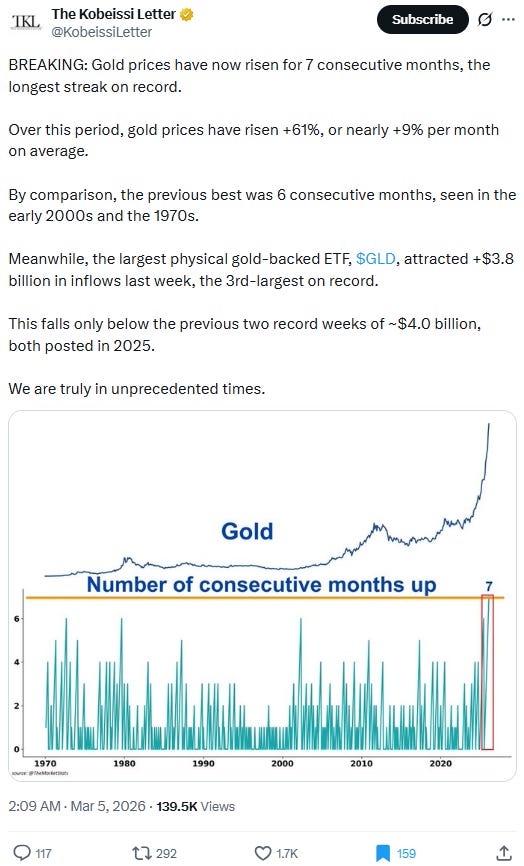
1/ Even though gold wasn’t much talked about in February, it quietly broken another record.
https://x.com/KobeissiLetter/status/2029378834227691532?s=20
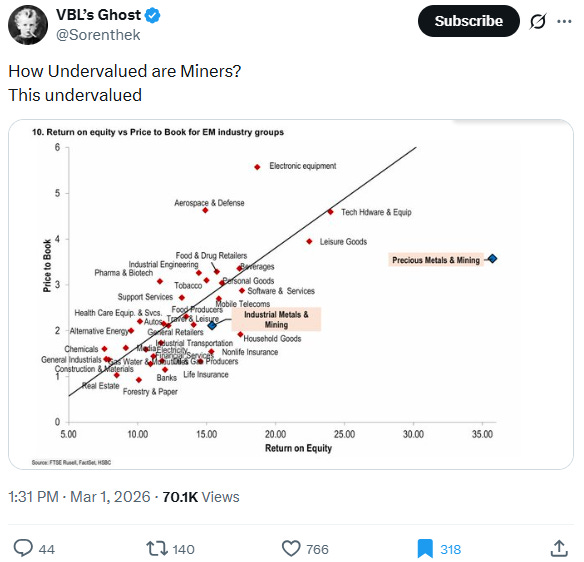
2/ And yet, investors don’t seem to believe the gold price will consistently remain elevated long enough to make the miners more appealing.
https://x.com/Sorenthek/status/2028100789227405439?s=20
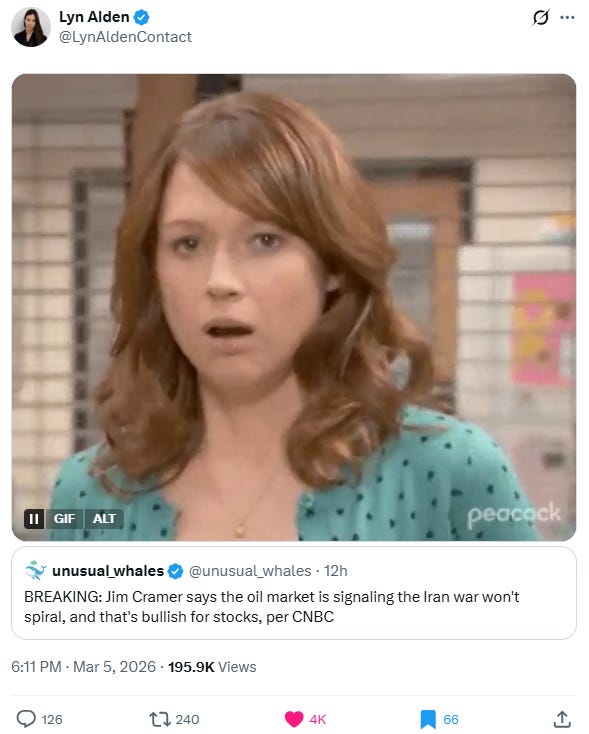
3/ What does Jewish eschatology say about Jim Cramer? Is he part of the prophecy?
https://x.com/LynAldenContact/status/2029620945527476542?s=20
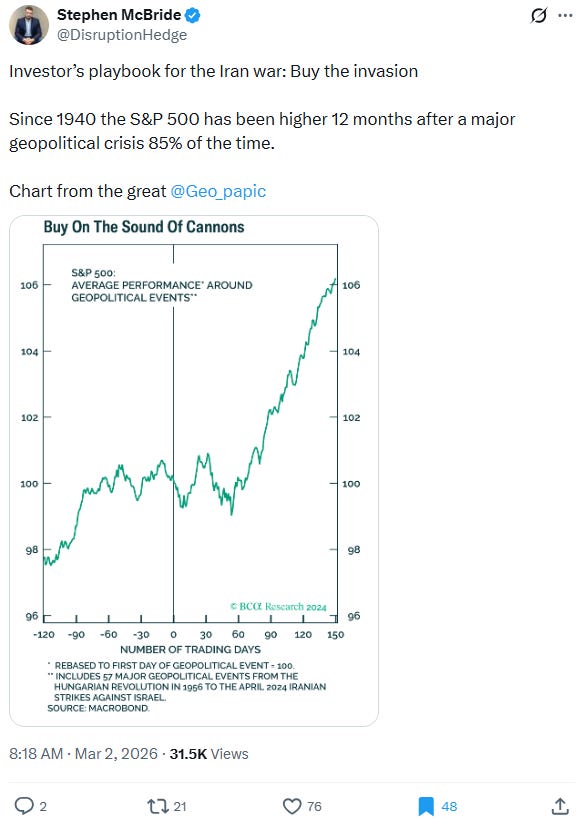
4/ The truth is that history appears to be on Cramer’s side. US equities tend to shake off whatever conflict is going on.
https://x.com/DisruptionHedge/status/2028384451412250971?s=20
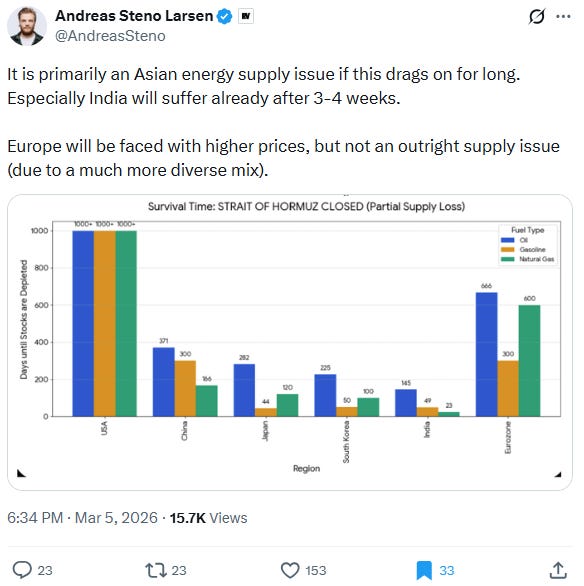
5/ But hardly everyone is immune. Being extremely dependent on Middle Eastern oil, the Asian countries are going to feel the brunt.
https://x.com/AndreasSteno/status/2029626517521633675?s=20
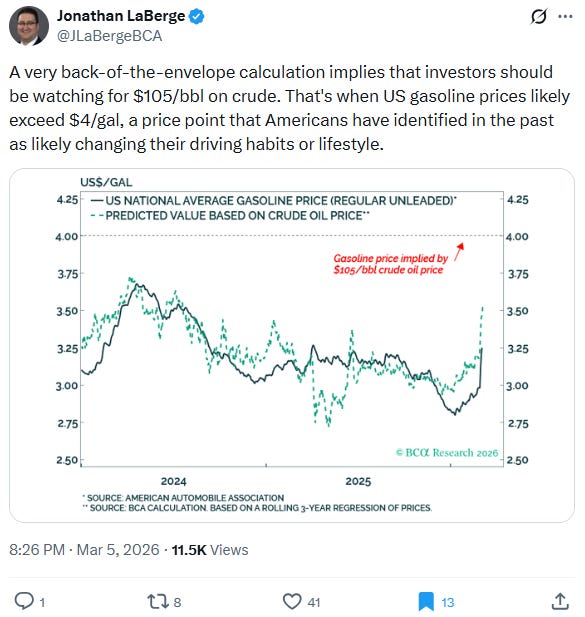
6/ Nevertheless, in case of a protracted war, before the US oil industry manages to open more rigs, the Americans are going to feel the pinch in the gas station.
https://x.com/JLaBergeBCA/status/2029654832160624890?s=20
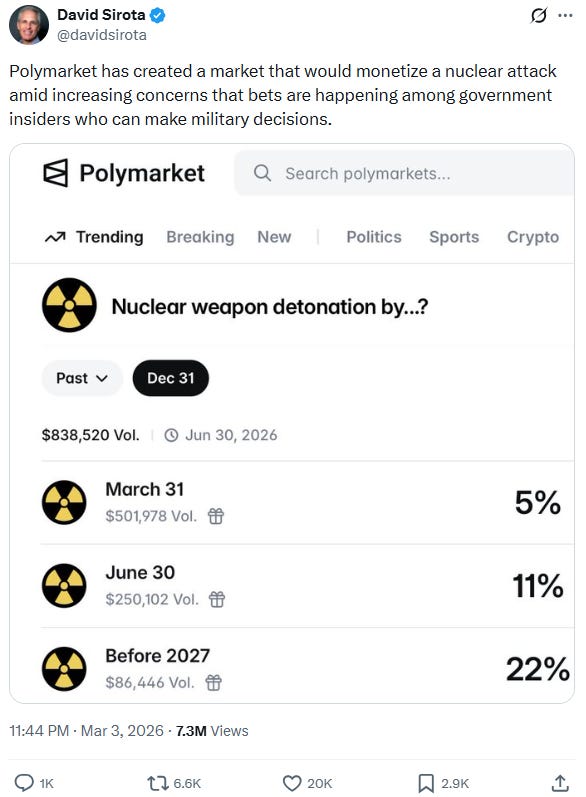
7/ The gamification of the economy and betting addiction has gotten out of control. How could anyone root for a nuclear strike? Might as well bet on the Rapture.
https://x.com/davidsirota/status/2028979804561916211?s=20
8/ Another domino to fall. Astonishingly, with all that is happening, financial markets are shrugging it all off.
https://x.com/UnicusResearch/status/2029550674468327740?s=20
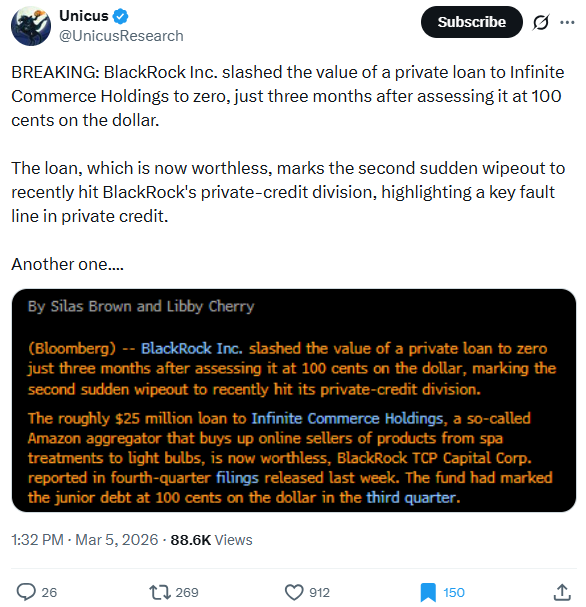
9/ Plainly, the distress in private credit and private equity has been contained… so far.
https://x.com/awealthofcs/status/2029224482213089545?s=20
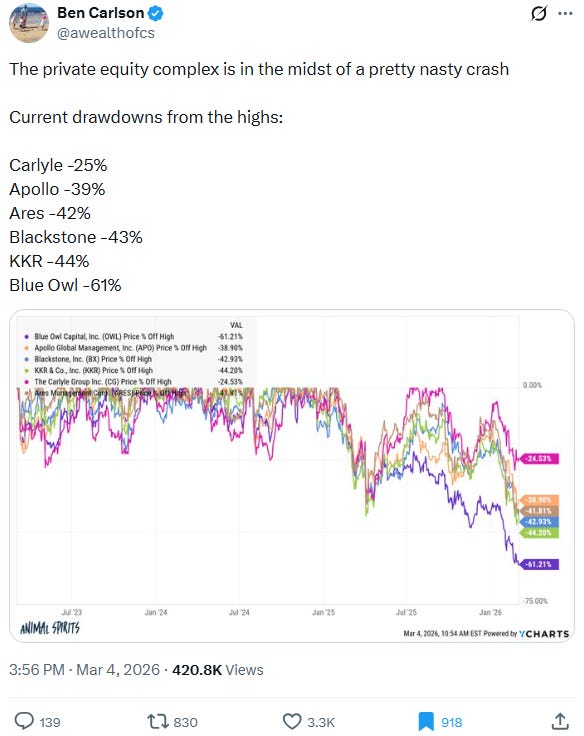
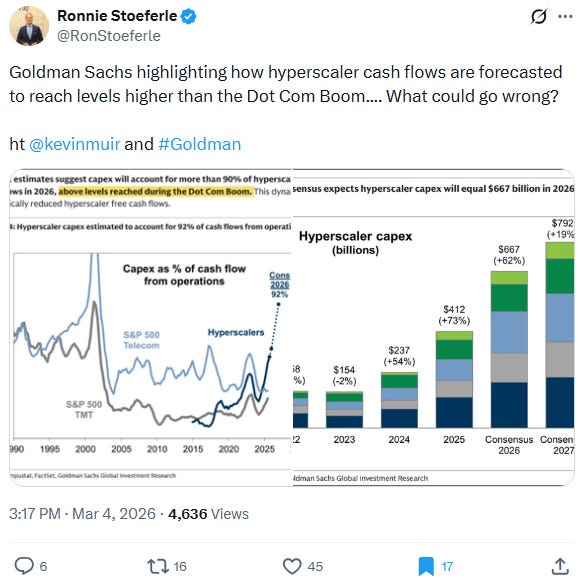
10/ The AI boom better pay off. A lot is on the table.
https://x.com/RonStoeferle/status/2029214532816826694?s=20
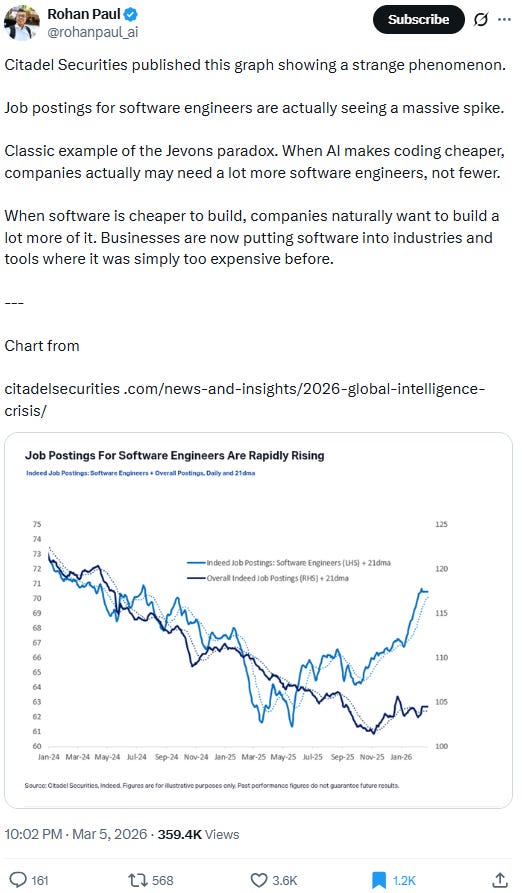
11/ One thing is for sure, the death of the computer programmers has been greatly exaggerated.
https://x.com/rohanpaul_ai/status/2029679074868879852?s=20
Cartoons/Memes
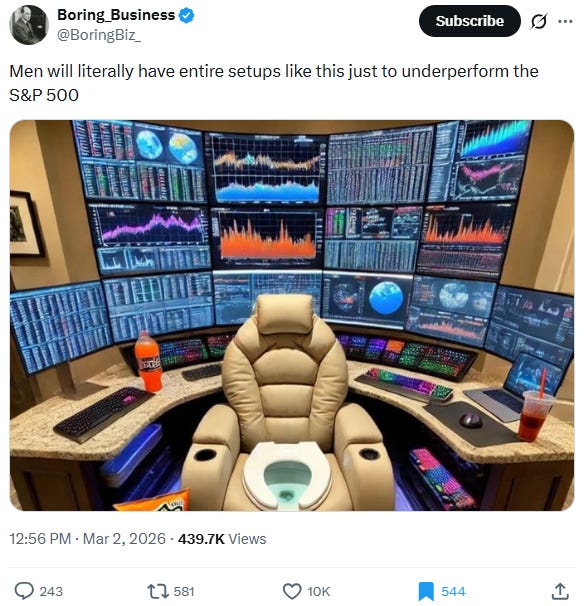
1/ In scary days like these, one could really use a seat like that.
https://x.com/BoringBiz_/status/2028454512793444843?s=20
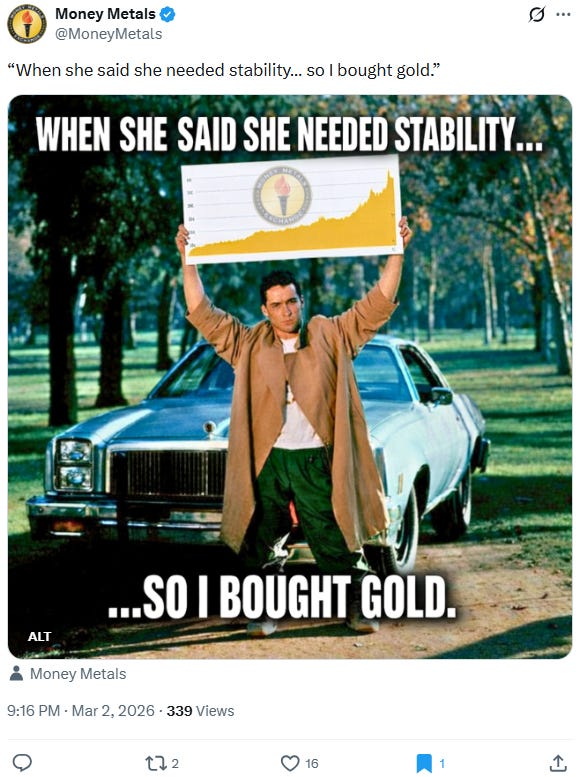
2/ Or you could hold on to some gold and avoid the runs.
https://x.com/MoneyMetals/status/2028580121804746855?s=20
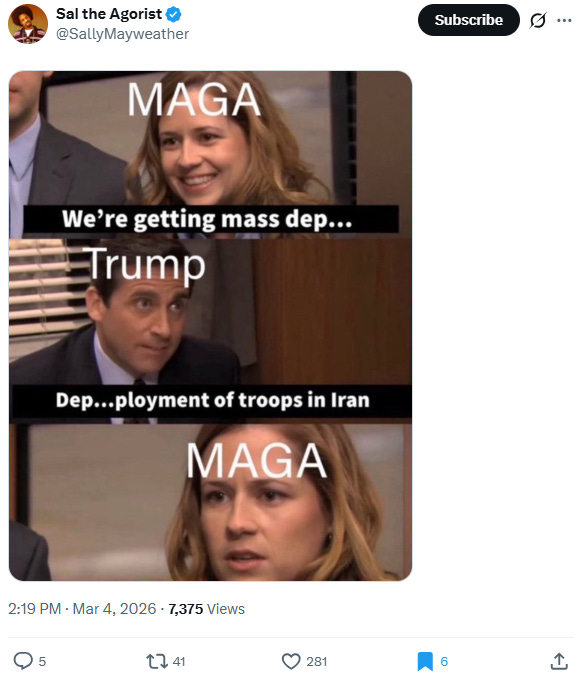
3/ Promises made, promises ke... nevermind.
https://x.com/SallyMayweather/status/2029200088971571630?s=20
Podcasts/Interviews/Presentations
1/ Biggest Bank in China Runs Run Out of Gold Bars. Supply Shortage Intensifies. | maneco64
Commentary
The recent video by Maneco64 follows a familiar script common in the precious metals’ commentary space: start with a valid observation and end with an exaggerated systemic conclusion. To be fair, he correctly notes that trading in gold and silver on major venues such as the LBMA and COMEX is highly leveraged, with far more paper contracts than physical metal. Notwithstanding, he never explains why a structure that has existed for decades is suddenly on the verge of collapse.
Furthermore, he also claims that strong physical demand is draining inventories from Western exchanges, while ignoring that the same trend, often even more pronounced, is occurring in Asia, particularly on the Shanghai Gold Exchange and the Shanghai Futures Exchange.
Similarly reductive is his explanation for the gold rally since 2025: delays at the LBMA triggered by tariffs introduced during the current Trump administration supposedly destroyed investor trust and fueled the rush into gold. In reality, the rally is better explained by rising geopolitical tensions, renewed trade protectionism, expectations of a more dovish stance from the Federal Reserve, and the persistent expansion of global debt and liquidity.
Ultimately, the analysis reflects a narrow worldview in which nearly every global problem is blamed on central banks and fiat money. However, wars, trade disputes, debt accumulation, and resource competition are not simply byproducts of fiat currency systems. In truth, they are far more complex dynamics that cannot be boiled down to a single money-related explanation.
To conclude, reducing the complexity of global economics to a single culprit may make for compelling YouTube narratives to what appear is an increasingly moronic and irrational audience. At any rate, it does little to illuminate the real forces shaping today’s financial landscape.
2/ Brent Johnson on the Iran War — BULLION BREAK, Ep. 1 | GoldRepublic
This first episode of Bullion Break, produced by GoldRepublic during the FUTURE OF GOLD event in Cape Town, features macro strategist Brent Johnson discussing the geopolitical and market implications of the recent escalation in the Middle East. The interview took place on March 2, 2026, just two days after the United States and Israel launched Operation Epic Fury, a large-scale military campaign targeting Iranian military infrastructure.
Johnson makes a particularly compelling point regarding how many observers misinterpreted the U.S. government’s 2025 National Security Strategy. Because the document emphasized the Western Hemisphere and homeland security, some analysts concluded that the United States was retreating from its global role. Johnson argues this is a misunderstanding: great powers do not abandon global engagement simply because they prioritize their own region. Maintaining a worldwide presence is precisely what hegemons do.
From this perspective, the conflict with Iran fits into a broader strategic framework rather than representing a sudden or isolated crisis. Johnson suggests that Washington’s actions – much like earlier pressure on Venezuela this year – should be viewed partly through the lens of great-power competition with China. Visibly, Iran and the wider Middle East remain central to global energy flows, and constraining Iran could indirectly limit China’s access to crude oil, a resource on which its economy heavily depends.
For financial markets, this geopolitical dynamic reinforces the importance of commodities and safe haven assets. Naturally, through escalating this conflict in a key energy region supports demand for gold and silver, not merely as monetary hedges, but as geopolitical insurance in an increasingly fragmented global order.
Quotes
1/ “Could this be the start of World War III? It’s not a crazy question. But I prefer Gulf War III—and Cold War II.” – Niall Ferguson.
https://x.com/nfergus/status/2029693998420435141?s=20
2/ “The idea that bureaucrats have outlined a somewhat genius strategy that will work out exactly as intended is somewhat comical, to be honest. But that’s what many global macro people want to sell to me at the moment.” – Fabian Winstersberger.
https://x.com/f_wintersberger/status/2029562009952395413?s=20
3/ “We are experiencing the largest loss of oil supply in history (3X bigger than the 1973 Arab oil embargo). The level of complacency to me is staggering. Prior playbooks do not apply!” – Eric Nuttall.
https://x.com/ericnuttall/status/2029590181183967700?s=20
Charts
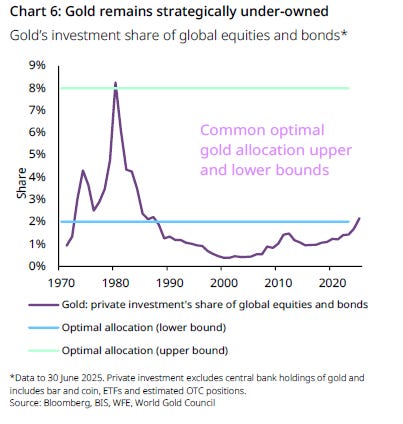
1/ There’s still plenty of room to go to invest in gold.
https://x.com/RonStoeferle/status/2029580415304916999?s=20
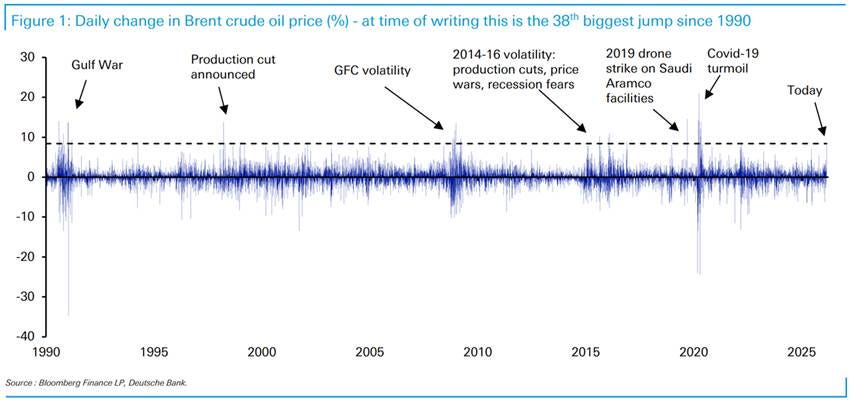
2/ Incredibly, despite the de facto closure of the Strait of Hormuz, the oil price didn’t jump as many would’ve thought. Clearly, the Gulf countries aren’t that relevant anymore.
https://www.zerohedge.com/energy/only-38th-largest-oil-spike-1990
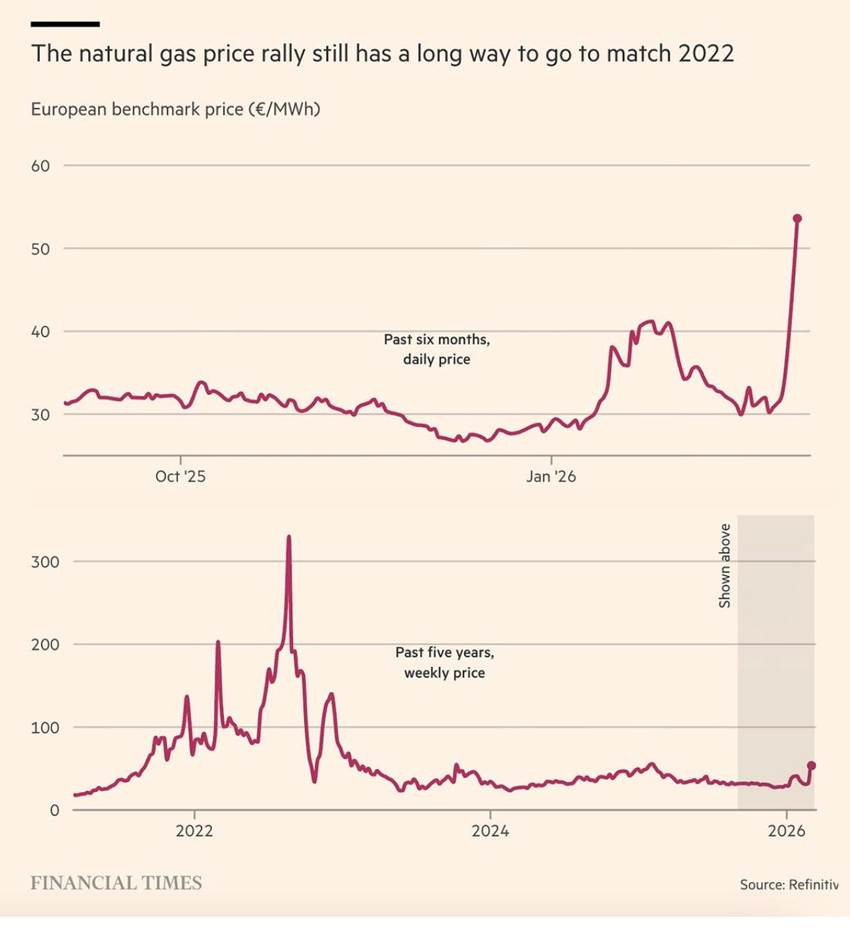
3/ Ditto for the natural gas market. As it seems, the economy has to all intents and purposes completely adapted to the new paradigm, with countries diversifying their sources of energy.
https://x.com/Benpagelondon/status/2029169445306806426?s=20
Articles/News
1/ Global Daily: The New Age of Empires
https://www.rabobank.com/knowledge/q011516453-global-daily-the-new-age-of-empires
Commentary
In last Monday’s daily update for Rabobank clients, Michael Every and Benjamin Picton interpret the recent U.S.–Israel strike on Iran, not as an isolated military action, but as part of a broader strategic contest between the United States and China. Essentially, their argument is that the move fits into a wider U.S. grand strategy aimed at preserving 21st-century hegemony by targeting the resource dependencies that underpin China’s rise.
Surely, China’s dominance in industrial supply chains, particularly critical minerals, has long been viewed as a structural vulnerability for the United States. The logical response, according to the authors, is to secure control over key raw materials that China depends on but cannot easily defend militarily. Evidently, energy resources are central to this approach, which helps explain both earlier U.S. pressure on Venezuela and the current confrontation with Iran, which is a far more significant supplier of oil to China.
They also suggest that weakening Iran could reshape broader geopolitical dynamics, including Russia’s energy leverage over China and the viability of major trade initiatives such as the India-Middle East-Europe Economic Corridor. Such a framework would link India and Europe through the Middle East while bypassing China’s Belt and Road Initiative.
Ultimately, the authors frame the strategy as a high-risk, high-reward gamble: if successful, it could rebalance supply chains and reinforce U.S. strategic leverage against China; if not, Washington risks escalating the conflict without achieving the intended geopolitical shift.
2/ Rothbard and War
https://mises.org/mises-wire/rothbard-and-war
Commentary
In his article on Murray Rothbard, Lew Rockwell revisits Rothbard’s long struggle to persuade the political right to reject interventionist foreign policy. Rothbard argued that supporters of free markets should be especially skeptical of war, since military conflict inevitably expands state power and undermines the voluntary cooperation on which a free society depends.
As Rockwell highlights, war is not merely destructive on the battlefield; it also corrodes economic and political institutions. In addition, it brings propaganda, censorship, surveillance, crony contracts, money creation, soaring public debt, and large-scale central planning. In this sense, war represents the ultimate government program, concentrating nearly every form of state intervention that advocates of a free economy normally oppose.
Moreover, Rothbard stressed that aggressive foreign policy is often strategically counterproductive because military pressure tends to push targeted countries toward rival powers that promise partnership or protection. During the Cold War this dynamic strengthened the Soviet Union, and similar patterns today can be seen in the growing influence of China and Russia among states seeking alternatives to Western pressure.
For this reason, the article is particularly important today, as it provides a powerful intellectual counterpoint to the reasoning often used to justify the geopolitical agenda and interventionist foreign policy of the United States. By recalling Rothbard’s critique, Rockwell reminds readers that war ultimately undermines both prosperity and liberty. Indeed, this point was long emphasized by Ludwig von Mises, who argued that peace, not war, is the true foundation of civilization and economic progress.